

Second Punic War: Causes, Course and How It Changed the West
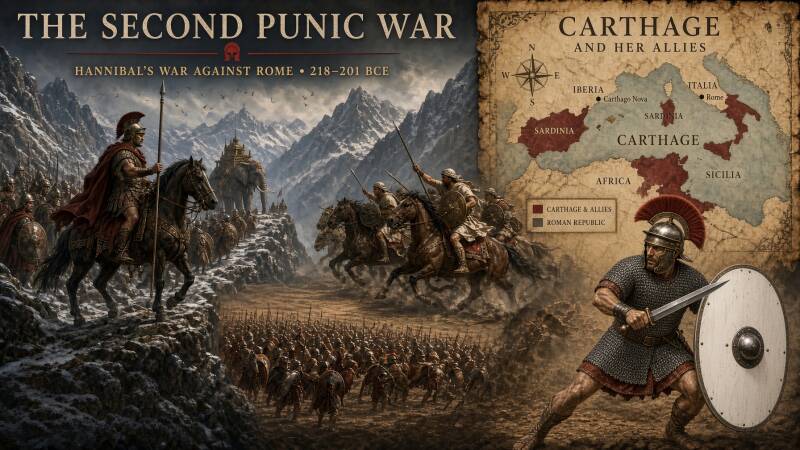
In 219 BCE the Carthaginian general Hannibal Barca laid siege to the Iberian city of Saguntum, a place that had ties with Rome. When the city fell, Rome demanded Hannibal’s surrender. Carthage refused. In 218 BCE Rome declared war. What followed was not a short punitive campaign but a sixteen-year struggle fought across Iberia, Italy, Sicily, Sardinia and North Africa. Rome ultimately won. The victory ended Carthage’s status as a Mediterranean great power and left Rome the dominant state in the western Mediterranean—an outcome that shaped the political, military and cultural trajectory of the West for centuries.
Why the war occurred
The Second Punic War did not begin with a single act. It grew out of the unfinished settlement of the First Punic War (264–241 BCE) and subsequent decisions by both sides.
The First Punic War ended with Carthage surrendering Sicily and agreeing to pay a large indemnity.
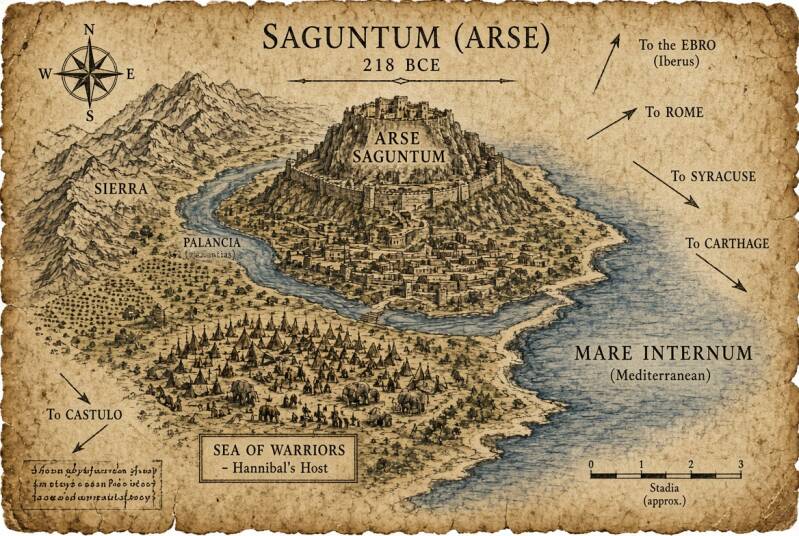
Almost immediately afterwards, Carthage faced a brutal revolt by its mercenary armies (the Mercenary or Truceless War). While Carthage was occupied suppressing this revolt, Rome seized Sardinia and Corsica and forced Carthage to accept an additional indemnity. The Greek historian Polybius, writing in the second century BCE and drawing on both Roman and Carthaginian sources (including material close to Hannibal), identified three underlying causes of the later war. The first was the anger of Hamilcar Barca, Hannibal’s father, who had commanded in Sicily and felt the peace had been forced upon him despite remaining undefeated in the field. The second—and, in Polybius’s judgement, the most important—was the Roman seizure of Sardinia, which created lasting resentment. The third was the success of the Carthaginian enterprise in Iberia, which gave Carthage both resources and confidence.
Hamilcar arrived in southern Iberia in 237 BCE. He, and later his son-in-law Hasdrubal the Fair, expanded Carthaginian control south of the Ebro River, founding or developing bases such as Akra Leuke and New Carthage (modern Cartagena). Around 226 BCE Hasdrubal accepted a Roman demand that Carthaginian forces would not cross the Ebro under arms—the so-called Ebro Treaty. The precise status of Saguntum, which lay south of the Ebro yet maintained relations with Rome, remains debated. Some modern scholars argue Rome’s connection with Saguntum predated the treaty; others see the city’s position as a source of ambiguity that both sides later exploited. What is clear is that when Hannibal assumed command in 221 BCE he continued the expansion and, in 219, besieged Saguntum after local disputes involving pro-Carthaginian factions. The city fell after a hard siege. Rome treated the action as a breach of faith; Carthage refused to disavow Hannibal. War followed in 218.
Polybius distinguishes between the deeper causes and the immediate “beginnings” of the war (the siege of Saguntum and the crossing of the Ebro). Livy, writing later under the early Principate, presents a more patriotic Roman narrative that emphasises Carthaginian aggression and the famous story of Hannibal’s childhood oath of enmity toward Rome. Both accounts have limitations: Polybius is incomplete after the early books and generally favourable to Rome; Livy is farther from the events and more rhetorical. No substantial Carthaginian narrative survives. Modern scholarship generally accepts Polybius’s framework while stressing mutual miscalculation, the competitive dynamics of two expanding states, and the difficulty of enforcing spheres of influence in Iberia.

The war in outline
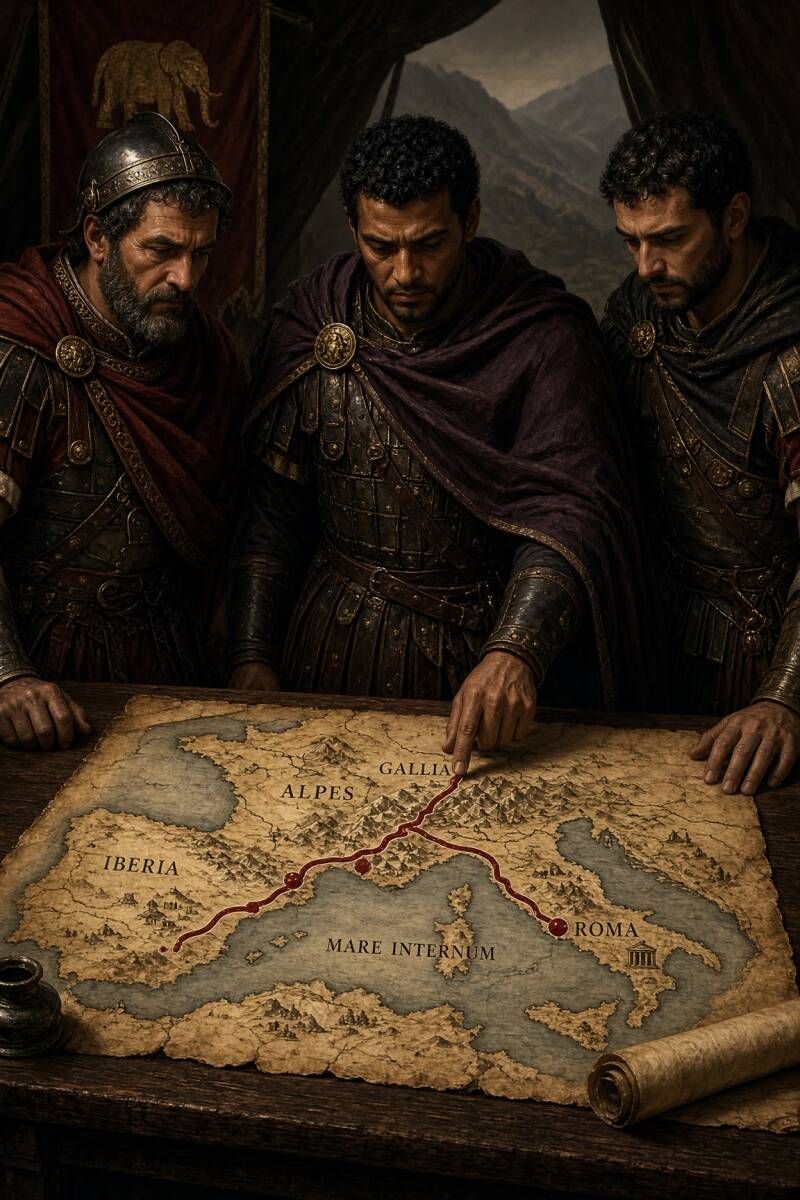
Rome expected the main fighting to occur in Iberia and possibly Africa. Hannibal chose a different strategy. In spring 218 he left New Carthage with a large multi-ethnic force that included Iberian, Libyan and other contingents, plus war elephants. After crossing the Pyrenees and the Rhône, he led the army over the Alps in late autumn. Polybius records that the march from New Carthage took five months and that the Alpine crossing itself took fifteen days. According to an inscription Hannibal later set up at Lacinium, he arrived in northern Italy with roughly 20,000 infantry and 6,000 cavalry—a severe reduction from the force that had left Iberia. Most of the elephants also perished.
In Italy Hannibal won a series of victories: the Ticinus and Trebia in 218, Lake Trasimene in 217, and the double envelopment at Cannae in 216, where Roman and allied losses were catastrophic (ancient figures run into the tens of thousands). Several southern Italian communities and, later, the city of Capua defected or wavered. Hannibal could not, however, force a political settlement or break Rome’s alliance system decisively. Rome adapted, in part by avoiding further large-scale pitched battles under the influence of the dictator Quintus Fabius Maximus, while continuing to raise new legions from its Italian manpower base. Fighting also continued in Iberia, Sicily and Sardinia. Carthaginian attempts to reinforce Hannibal from Spain or to open a second front with Macedon produced limited results.
The decisive shift came in Iberia and then Africa. After the deaths of the Scipio brothers in 211, the younger Publius Cornelius Scipio (later Africanus) took command, captured New Carthage in 209, and defeated Carthaginian forces at Baecula and, decisively, at Ilipa in 206. With Iberia lost, Scipio invaded Africa in 204. Hannibal was recalled from Italy. The two commanders met at Zama in 202 BCE. Scipio, with superior cavalry under the Numidian prince Masinissa, defeated Hannibal. Peace was concluded in 201. Carthage surrendered its overseas territories (including Iberia), gave up most of its warships, agreed to pay 10,000 talents over fifty years, and accepted restrictions on its foreign policy—it could not make war without Roman permission.
How the outcome altered the history of the West
Before the war Rome was the leading power in Italy with limited overseas possessions (Sicily, Sardinia and Corsica). After 201 it controlled the former Carthaginian territories in Iberia, possessed unchallenged naval supremacy in the west, and had demonstrated the ability to project power across the Mediterranean. The silver mines of Iberia and the grain of Sicily and Sardinia increased Rome’s resources. The war also produced large numbers of captives who entered the Roman slave economy, contributing to the growth of large estates (latifundia) and to social tensions that would later affect the late Republic.
Politically, the conflict elevated successful commanders. Scipio Africanus’s prestige showed that military achievement could translate into extraordinary personal authority, a pattern that intensified in the following century. Strategically, the removal of Carthage as an equal western rival allowed Rome to intervene more freely in the Greek east. Within a generation Rome was fighting Macedon and the Seleucids; within two generations it had destroyed Carthage itself in the Third Punic War (149–146 BCE).
The longer cultural consequence was the creation of a Mediterranean order under Roman leadership. Latin, Roman law, Roman roads and, eventually, the administrative and legal frameworks of the Empire spread across much of western Europe and the Mediterranean basin. While the Second Punic War did not create the Empire overnight, it removed the principal obstacle to Roman dominance in the west and gave Rome the confidence, resources and institutional experience to pursue further expansion. Without that victory the political map of the ancient Mediterranean—and therefore the foundations of later European civilisation—would have looked substantially different.

Iberia itself was central to these events. Carthaginian recruitment of Iberian warriors, the campaigns of the Scipios, and the eventual Roman provincial organisation of Hispania all shaped the peninsula’s history. The peoples of Iberia were not passive participants; their choices of alliance, resistance or accommodation affected the balance of the war.
Sources and further reading
The principal ancient accounts are Polybius, Histories Books 1–3 (and surviving extracts of later books) and Livy, Ab Urbe Condita Books 21–30. Both must be read with their biases and distance from events in mind. Useful modern introductions include Dexter Hoyos (ed.), A Companion to the Punic Wars (Wiley-Blackwell) and Arthur M. Eckstein, Mediterranean Anarchy, Interstate War, and the Rise of Rome. Archaeological evidence for the period in Iberia continues to refine our understanding of settlement, fortification and material culture, though it rarely settles specific tactical questions.
Discover the novels
The Sons of Iberia series by J. Glenn Bauer explores the Second Punic War from the perspective of the Iberian peoples rather than solely through Roman or Carthaginian eyes. The prequel Spears for Sparta is set in the fourth century BCE. Historical evidence and fictional narrative are distinct; the novels use researched context to tell a story of survival and shifting alliances among the tribes of ancient Iberia. More information is available at www.jglennbauer.com.